
Tallahassee’s three City Commission races told three different stories. Jeremy Matlow’s early-voting advantage carried him to a 1,365-vote win for mayor, with strong turnout at campus early-voting sites. PJ Perez won Seat 3 by a wide margin in a race where Election Day results closely tracked party turnout. Dianne Williams-Cox won Seat 5 by 2,346 votes, powered by her Election Day lead. Here’s what the numbers show across all three races and what I think they mean.
Mayor
First, congratulations to Mayor-elect Jeremy Matlow. I texted him personally after his victory, and I sincerely hope he can bring our community together and move Tallahassee toward a better future.
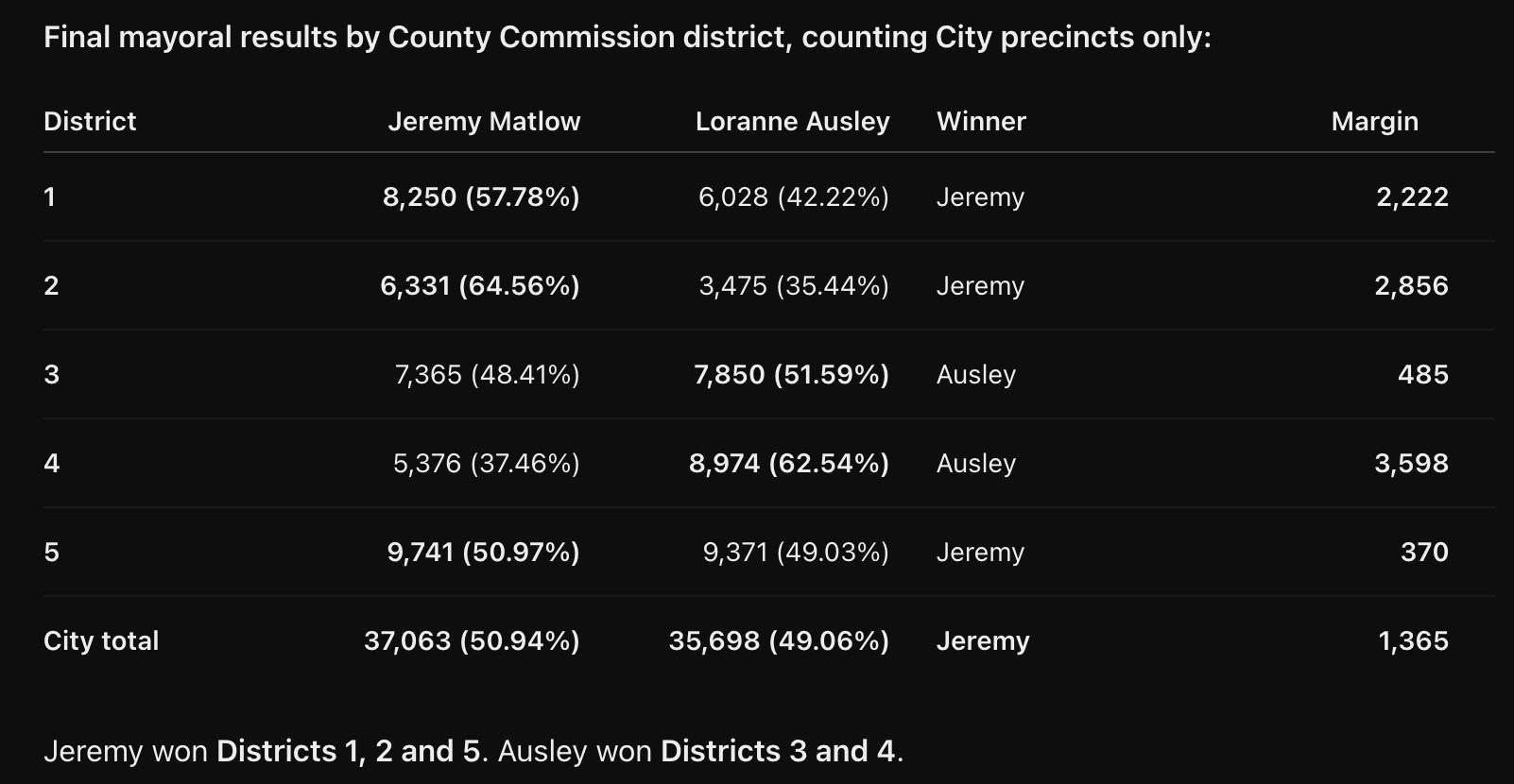
Let’s get into the numbers. Matlow finished just 0.94 percentage points above 50%. Breaking down the results by precinct and voting method tells an interesting story.
Ausley won vote by mail by 509 votes and Election Day by 242 votes. But Matlow’s 2,116-vote advantage in early voting overcame both, giving him a final winning margin of 1,365 votes.
With an early-voting advantage that large, let’s take a closer look at two campus early-voting sites.
| Early-voting site | 2022 turnout | 2026 turnout |
|---|---|---|
| FSU Student Union | 1,985 | 5,535 |
| FAMU Student Union | 507 | 2,536 |
Another striking finding comes from the precinct results. Across four of the city’s 80 precincts in the FSU area—1302, 1503, 1507 and 2503—Matlow received 70.65% of the mayoral vote and built a 1,411-vote advantage. His final citywide winning margin was 1,365.
Remove those four precincts from the totals, and Loranne Ausley wins the remaining 76 precincts by 46 votes.
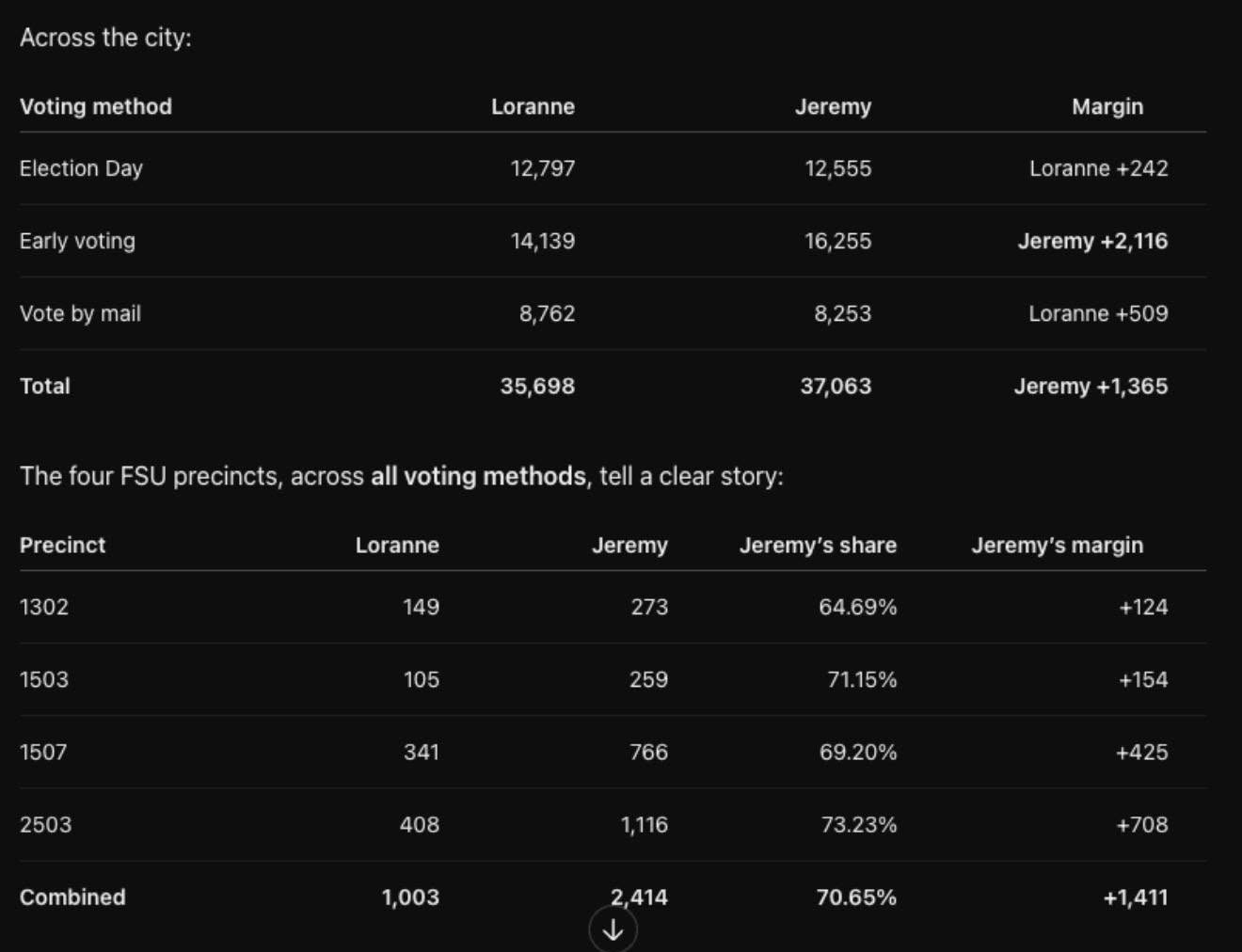
That is how much these four FSU-area precincts mattered. Their combined advantage for Matlow exceeded his entire margin of victory.
You see the point I’m making. Across the rest of the city, Matlow struggled to pull ahead. Districts 3 and 5 were both close.
Matlow lost District 3 by 485 votes. The Tharpe Street area has historically been strong territory for him, but this time it wasn’t enough to overcome Ausley’s advantage elsewhere in the district, including neighborhoods such as Betton Hills and Waverly.
I consider District 5 his base. It includes Lafayette Park, Myers Park, Indian Head, Woodland Drive and surrounding neighborhoods. Yet he won the district by just 370 votes.
Ausley’s strongest district was District 4, where she built a 3,598-vote advantage. Matlow countered with a combined 5,078-vote advantage in Districts 1 and 2, which include all four FSU-area precincts.
A win is a win. Matlow worked hard, doubled down on student turnout, and put time, effort and money into getting those votes. It paid off.
But here’s my final take.
A narrow victory is not a mandate to change everything Jeremy Matlow will inherit as mayor. Almost half the voters chose Ausley. To me, that shows how much her message of unity and stability resonated.
I hope Mayor-elect Matlow understands that his new 3–2 majority must also serve the thousands of people who did not vote for him and did not vote for “burning it all down.” This is his opportunity to bring people together and win over residents who remain unconvinced.
I’m certainly looking forward to seeing his progress.
City Commission — Seat 3
I’m going to open with a very basic data point.
Leon County has 90,927 registered Democrats and 54,937 registered Republicans. Among voters registered with those two parties, Democrats account for 62.34% and Republicans for 37.66%.
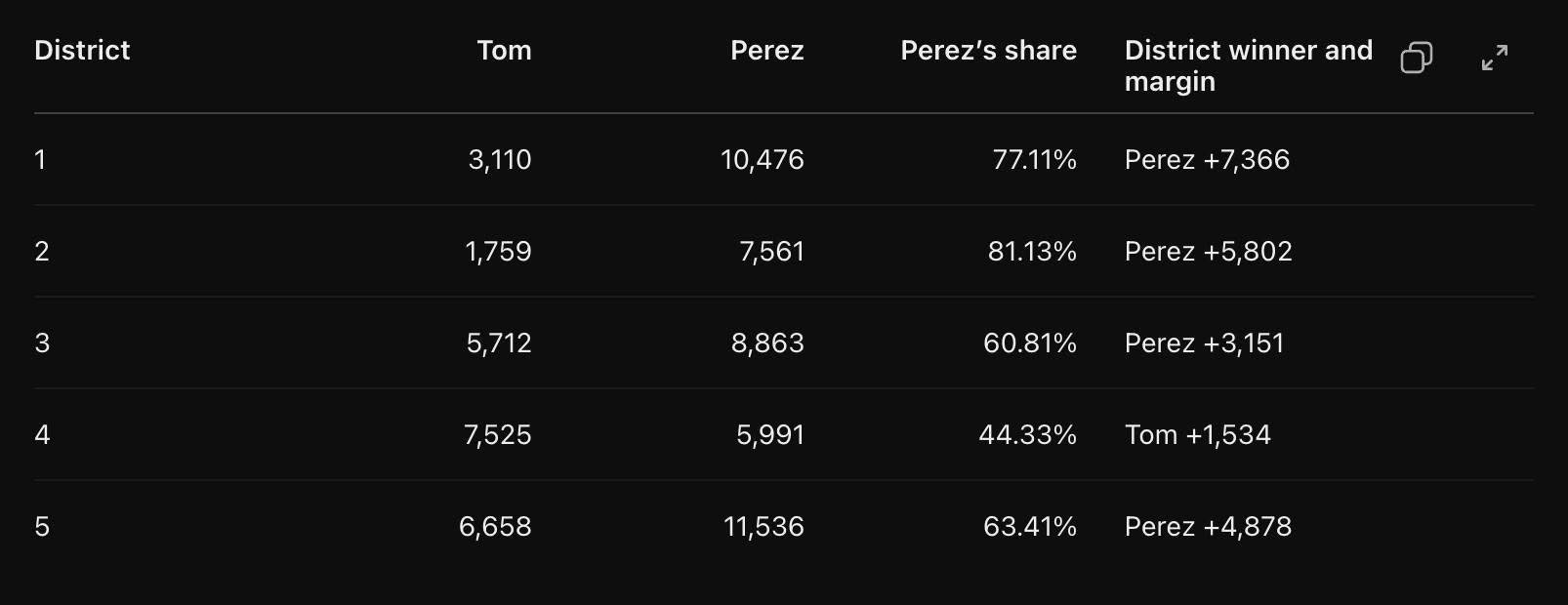
Now look at the Seat 3 results. Tom Derzypolski received 35.79%, and PJ Perez received 64.21%.
Obviously, that comparison alone proves nothing. We’re comparing countywide registration with a city election, and the registration ratio excludes voters with no party affiliation (NPAs) and minor-party voters. Still, I thought the similarity was interesting.
So I took a deeper look.
I compared Election Day party turnout with candidate results at 25 city-only polling locations covering 27 precincts, representing roughly half of the race’s Election Day votes.
The correlation between Republicans’ share of voters and Tom’s share of Seat 3 votes was +0.971. A perfect positive correlation would be +1.00.
PJ’s vote share also closely tracked Democratic turnout, with a correlation of +0.933.
Both figures show a strong relationship between party composition and the results across those polling locations.
Tom lost every district except District 4, where he won by 1,534 votes.
When I compare that with Ausley’s 3,598-vote advantage in the same city precincts, my tentative conclusion is that some Democrats in District 4 were willing to vote for Ausley but not for Tom.
I also compared PJ Perez’s vote share against Tom with Matlow’s vote share against Ausley. Perez received a higher share than Matlow in 79 of 80 precincts.
| Precinct | Matlow | Perez |
|---|---|---|
| 1317 — Jake Gaither Community Center | 45.26% | 73.56% |
| 3110 — Leon County Public Works | 49.77% | 61.68% |
| 5225 — Southwood Community Center | 40.02% | 50.47% |
That tells me a Democrat like Ausley or Williams-Cox can split the Democratic vote with another Democrat. But once the “right-wing Republican” label enters the race, it becomes a powerful line of attack.
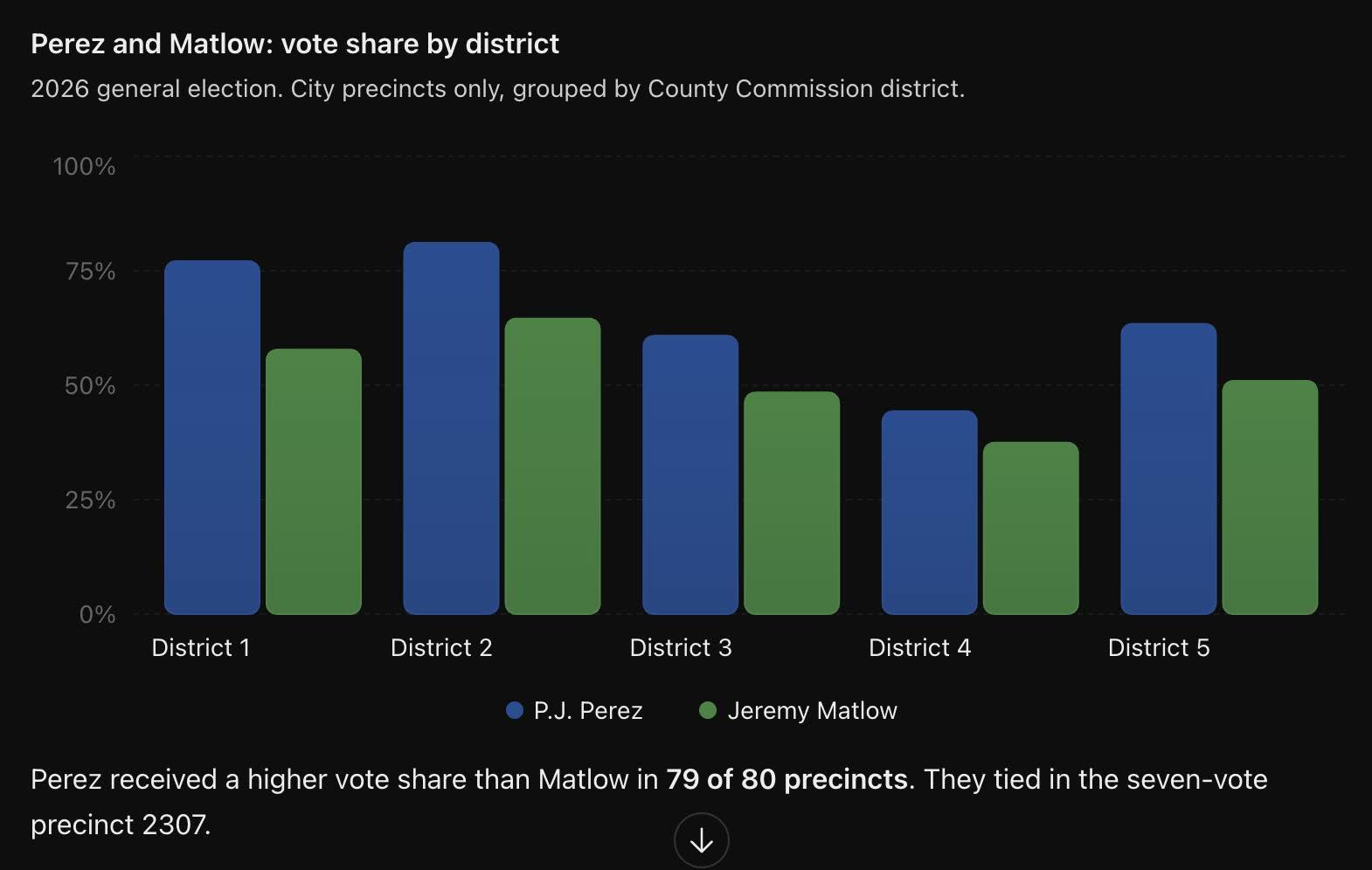
My takeaway is that, in today’s hyperpartisan Tallahassee, a Republican connection can overshadow almost everything else about a candidate.
Ryan Ray, Matlow’s aide and the local Democratic Party chair, is quick to brand opponents outside the party “right-wing extremists.”
Being a Republican, or having been one, gives him an easy line of attack. So does donating to Republicans, having Republican donors, or endorsing a Republican candidate on social media. Any Republican connection becomes ammunition.
Some of us learned that lesson from the 2022 race between David Bellamy and Jeremy Matlow. Some of us didn’t.
Tom was registered with no party affiliation. But his Republican history became the label that followed him through the general election.
On August 19, the day after the primary, PJ’s campaign sent a text message portraying Tom as a right-wing Republican. It appeared to target Democrats and Democratic-leaning NPA voters.
Game over.
A lot of influential people in this community were told Tom had a real chance to win. I gave him a 0% chance, and the result confirmed my read of the race.
Maybe as a community, or even as a nation, we’ll mature one day and judge candidates by their record, experience, judgment and ability to do the job. Maybe we’ll learn to look beyond the D-versus-R goggles we wear.
But not today. And apparently not anytime soon.
My other takeaway is that progressives targeted Talethia Edwards in the primary because they saw her as the tougher general-election opponent.
A Black woman.
A Democrat.
A graduate of both FSU and FAMU who’s still active with both universities.
Deep roots in the community.
Strong name recognition. Endorsed by the PBA.
Tom offered progressives an easier path in November.
So, here we are.
I don’t know much about PJ, and judging by the pre-election polling, I’m not alone. The polls I saw put his name recognition at around 10–15%.
I believe the methods progressives used to get him elected, including deliberate and calculated attacks on Talethia Edwards, have overshadowed who he is and raised questions about how he’ll govern.
But only PJ can change that perception.
Political circles expect him to rubber-stamp everything Matlow does. Maybe he will.
Maybe he won’t. Maybe we now have a young, very intelligent and fair commissioner who will approach each issue with reason and independent judgment.
Time will tell.
City Commission — Seat 5
This was a more classic matchup between a progressive Democrat and a moderate Democrat, similar to Dot’s race against Curtis Richardson two years ago or Dailey’s race against Dozier in 2022.
But this time, Dianne Williams-Cox was better prepared and fought back much harder.
Let’s get the basic numbers out of the way first.
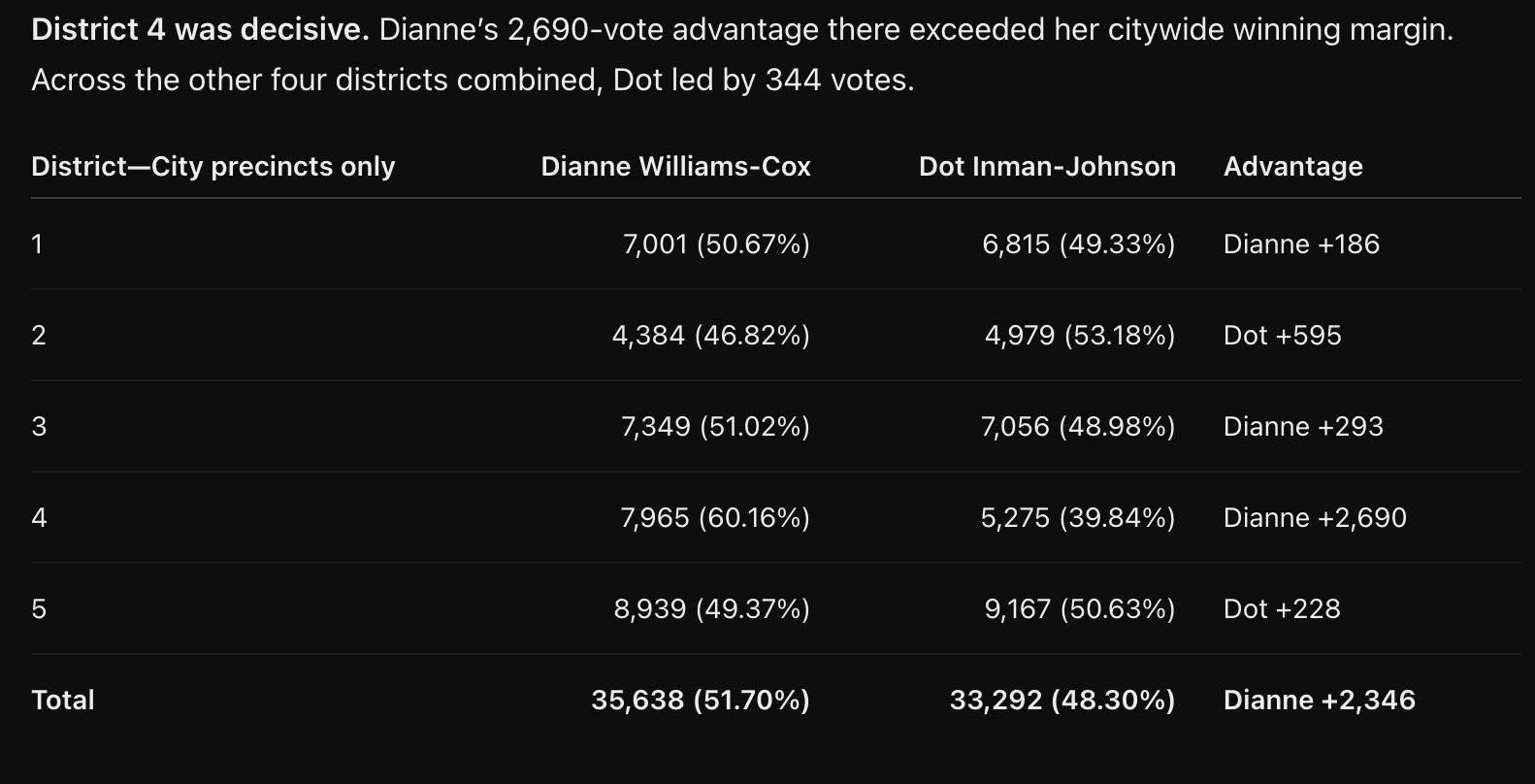
Dianne won by 2,346 votes, a margin of 3.40 percentage points. She led by 2,464 votes on Election Day and another 425 in early voting. Dot won vote by mail by 543 votes.
Dianne carried Districts 1, 3 and 4, while Dot carried Districts 2 and 5.
Dot’s largest district advantage came in District 2, where she led by 595 votes. Dianne countered with a whopping 2,690-vote advantage in District 4, in Northeast Tallahassee.
At the precinct level, Dianne carried 47 precincts to Dot’s 33, sweeping all 11 city precincts in District 4.
Dot carried the same four FSU-area precincts—1302, 1503, 1507 and 2503—by 645 votes, receiving 1,874 votes to Dianne’s 1,229.
A couple of takeaways.
The mayor’s race received 72,761 votes, compared with 69,191 in Seat 3 and 68,930 in Seat 5. That’s 3,570 fewer votes in Seat 3 and 3,831 fewer in Seat 5. It’s a noticeable drop-off from the mayor’s race to the other city races.
The comparison with the last presidential election is also striking. In 2024, the Seat 2 race between Curtis and Dot drew 82,876 votes.
In other words, a City Commission race during the presidential cycle drew 10,115 more votes than this year’s mayoral race during the midterms. What would these results have looked like if another 10,000 people had voted in all three city races? I’d certainly be interested to see.
Dianne also performed substantially better than Loranne in the four FSU-area precincts. Matlow received roughly 70% of the mayoral vote there to Ausley’s 30%. In those same precincts, Dot received roughly 60% to Dianne’s 40%.
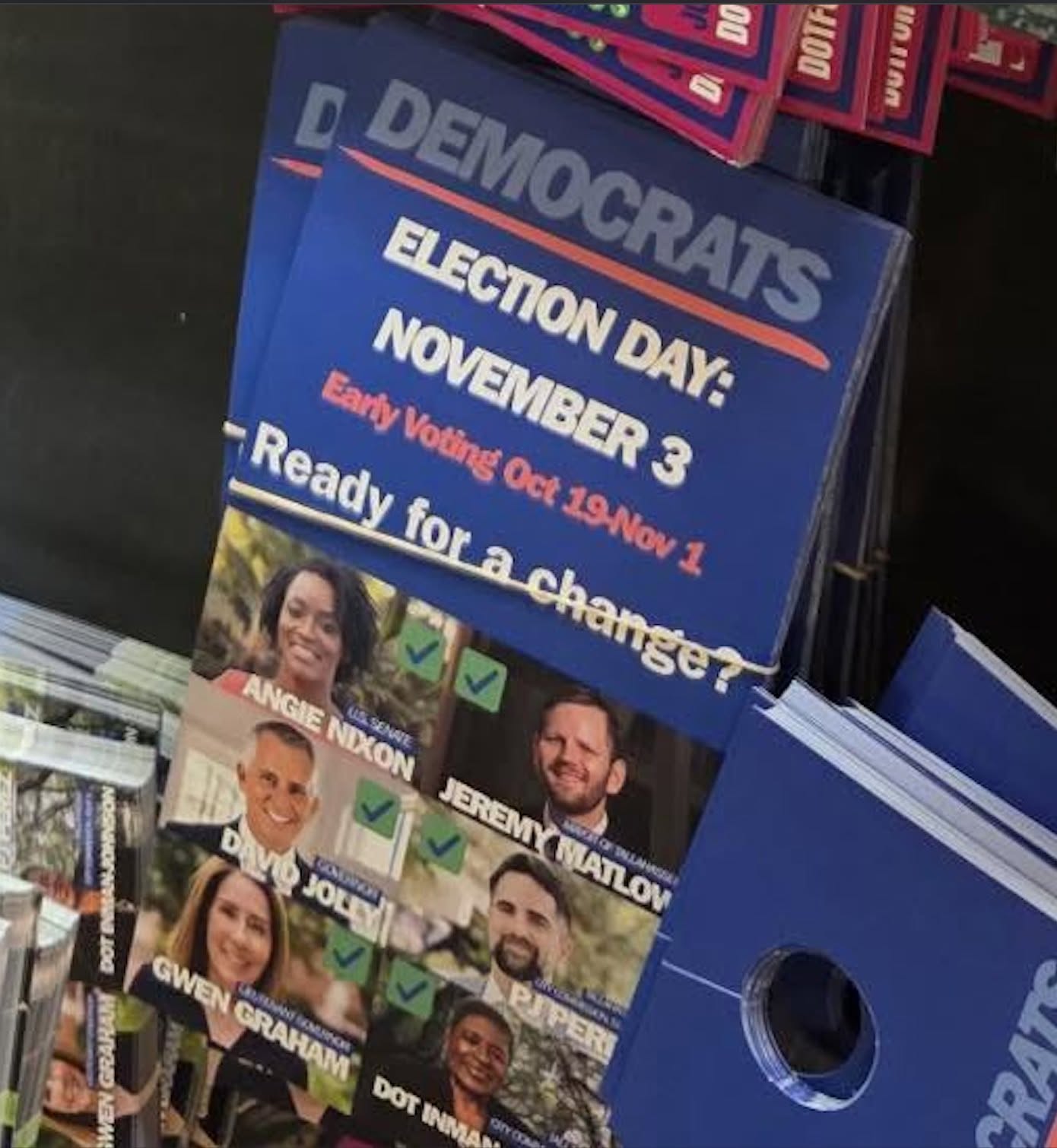
Keep in mind that progressives distributed a slate card to students with “DEMOCRATS” in large print at the top.
It listed Angie Nixon for Senate, Jolly/Graham for governor and Amanda Marie Green for the House of Representatives. It went on to list Jeremy Matlow for mayor, PJ Perez for Seat 3 and Dot Inman-Johnson for Seat 5.
I believe that framing was intentionally misleading. Loranne Ausley and Dianne Williams-Cox were Democrats too. A student relying on that card would have had no way to tell.
The progressive candidates carried those precincts in all three city races. Dianne still made her race considerably more competitive there.
Here’s my read on the politics behind this race.
Initially, Joe Kalicki and Tifany Hill were recruited to challenge Dianne Williams-Cox. The apparent strategy was straightforward. Joe would draw white progressive Democrats, while Tifany would split the Black vote.
I believe they eventually realized that this lineup could allow Dianne to clear 50% in the primary. Neither Joe nor Tifany had much name recognition in Tallahassee. They needed a stronger challenger to keep Dianne from winning outright.
So Joe stepped aside, and Dot came in. Progressives had spent more than $500,000 in the previous cycle, and Dot already had the name recognition the other candidates lacked.
In my view, bringing her into the race was about forcing Seat 5 into the general election.
That part worked.
Meanwhile, the support they had promised Tifany shifted overnight to Dot.
But why? I believe the broader calculation was financial. They assumed non-progressive donors had a limited pot of money. Forcing Dianne into the general election would spread that money across three campaigns: Dianne, Loranne and whoever faced PJ, whether Tom or Talethia. That would leave less money to concentrate on the mayor’s race.
That calculation backfired. The additional fight drew more money into the local elections than anyone anticipated.
Congratulations to Commissioner Dianne Williams-Cox. She fought hard and showed that her support reaches across this community. She built a broad coalition of voters, donors and grassroots supporters, and it paid off.
← Insights & Analysis